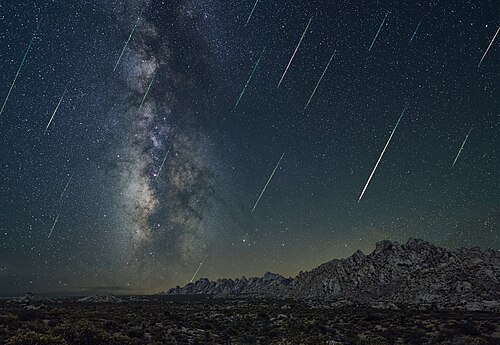
This year's Perseid meteor shower has already come and gone, peaking Aug. 12-13. But astronomers say the real spectacle may still be ahead - in 2028.
According to meteor expert Robert Lunsford of the American Meteor Society, Jupiter's gravity periodically nudges a section of Comet Swift-Tuttle's debris trail closer to Earth's orbit, a cycle tied to Jupiter's roughly 12-year orbit. The next close pass lines up with the 2028 Perseids, potentially boosting hourly rates well above normal.
"The 2028 passage indicates that some particles will shift into an orbit closer to Earth so that hourly rates could be higher than usual," Lunsford told Space.com.
Lunsford says 2027's Perseid activity should offer an early clue. "If rates during 2027 are enhanced to at least 100 per hour, then we can expect 200-300 per hour for 2028," he said, though he cautioned that predictions are still closer to educated guesses than certainties, since scientists lack precise data on how densely packed the debris stream actually is.
Some meteor scientists have gone further, floating the possibility of an outright meteor storm, with rates topping 1,000 per hour, based on separate calculations involving a dense filament of debris Swift-Tuttle shed centuries ago.
If the timing holds, moon conditions in 2028 look favorable too, with a third-quarter moon that won't wash out the show the way this year's near-full moon threatened to.
Until then, it's worth remembering that the same night sky Scripture calls "the work of His hands" keeps its calendar with a precision no human hand could manage - a quiet reminder well ahead of any outburst.
Related article: Perseid Meteor Shower Tonight: Is It Visible, and Which Way Should You Look?


