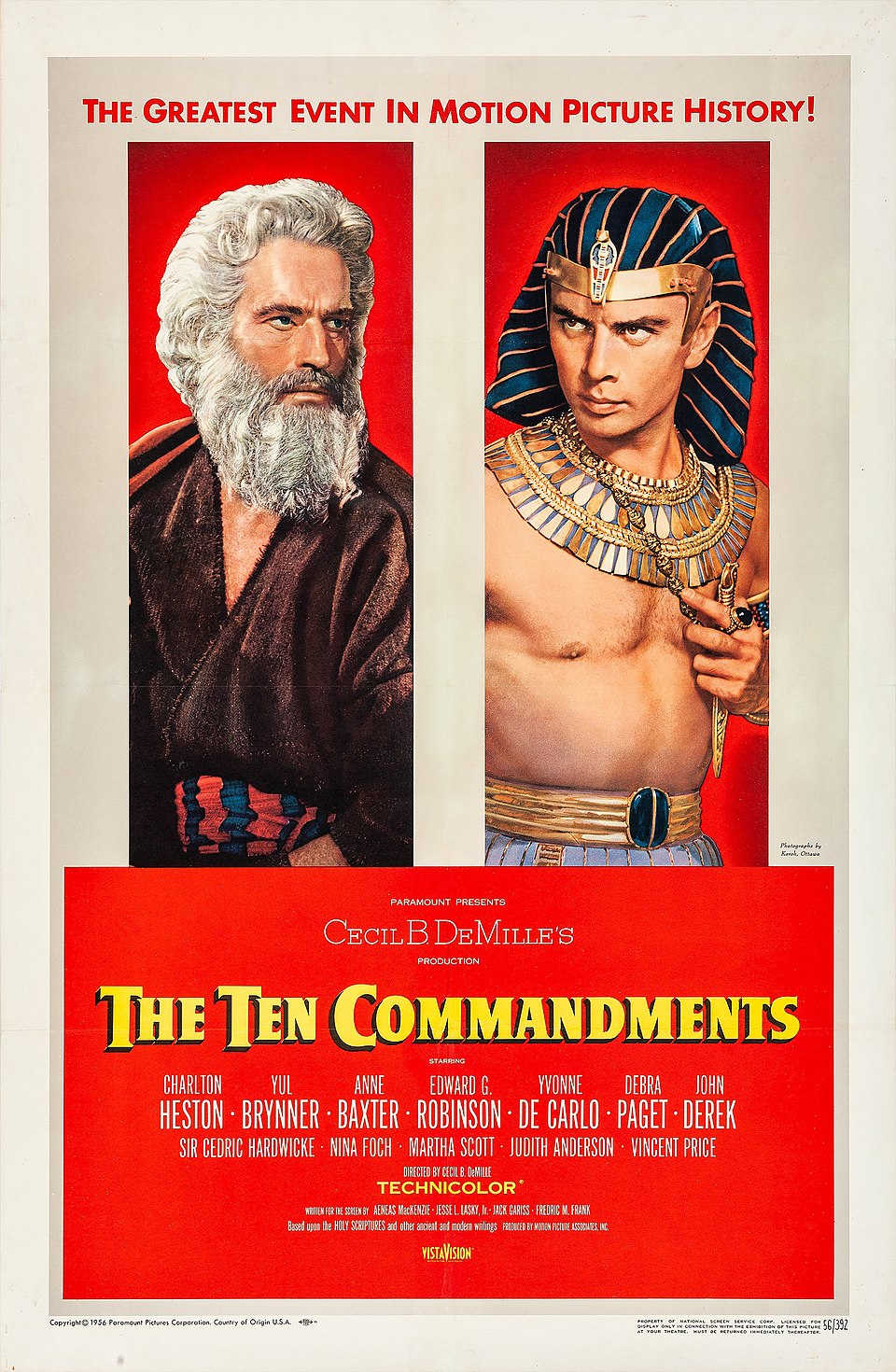
The Ten Commandments airs on ABC on Saturday, April 4, 2026 at 7 p.m. ET - and screens in select theaters March 31-April 2. Read our first report on the 70th anniversary theatrical release here.
Cecil B. DeMille's The Ten Commandments is one of the most watched films in television history - but how much do you actually know about it? Before you settle in this Easter season, here are 20 facts that will make the experience richer, more personal, and genuinely surprising.
1. It took five years to make. The 1956 epic required 1,200 storyboards, a 308-page script, 70 speaking roles, and five full years of production before it was ready for audiences.
2. DeMille had a heart attack during filming - and came back three days later. The director suffered a serious cardiac episode on set. His doctors ordered him to stop. He returned to work anyway, determined to finish what he had started.
3. DeMille was 75 years old when he made it. He was the oldest working director in Hollywood at the time. The Ten Commandments was his final film.
4. Charlton Heston got the role because of Michelangelo. DeMille saw Michelangelo's famous marble statue of Moses and felt it bore a striking resemblance to Heston. That image alone convinced him Heston was the right man for the role.
5. Heston also voiced God. During the burning bush scene, it is Charlton Heston's own voice - altered - delivering the words of God to Moses.
6. Baby Moses was played by Heston's real son. Fraser Heston, who was just three months old at the time of filming, played the infant Moses in the film's opening scenes.
7. The Red Sea did not part - the water did. The iconic parting scene was achieved by filming 350,000 gallons of water - thickened with gelatin - pouring into large tanks using wind machines, then playing the footage entirely in reverse.
8. The chariots were built in America, shipped to Egypt, and shipped back again. All the chariots used in the Egyptian sequences were constructed in the United States, transported overseas for filming, and then returned after production wrapped.
9. The Red Sea scene was saved for last - because the chariots were destroyed. The chariot sequences were so physically demanding that the vehicles were wrecked by the time filming was complete. Only then could the Red Sea scene be shot.
10. Sandstorm effects came from jet engines. The massive desert sandstorms seen in the film were created using jet plane engines provided by the Egyptian air force, strapped down and aimed at the set.
11. The film was shot in Egypt for 10 weeks. Production began on location in Egypt before moving to the Paramount lot in Hollywood for eight additional months of filming.
12. The jewelry was historically accurate. Every piece of jewelry worn by Anne Baxter as Queen Nefretiri and other cast members was based on authentic designs from the era of Ramses I, researched and recreated for the production.
13. Paramount's mountain turned red for the opening credits. The studio's signature Matterhorn logo was recolored red in the opening credits to represent Mount Sinai - a subtle but deliberate creative choice by DeMille.
14. Edward G. Robinson said this role saved his career. Actor Edward G. Robinson, who played the villain Dathan, had been nearly blacklisted in Hollywood due to his political associations. He credited his role in The Ten Commandments with rescuing his career entirely.
15. Yul Brynner spent much of production behind a camera. The actor who played Pharaoh was an avid photographer and spent his off-camera time documenting the entire production in photographs.
16. A wax figure was used for the death of Pharaoh's firstborn. The moment when Pharaoh's son is struck dead was filmed using a wax figure lying on an altar - one of many practical effects that predated modern CGI by decades.
17. The film's composer was a last-minute replacement. Elmer Bernstein - who went on to write some of the most iconic scores in Hollywood history - was only hired after DeMille's first choice, composer Victor Young, fell ill and was unable to take the project.
18. It was the highest-grossing film of 1956. The Ten Commandments dominated the box office upon release, earning more than $65 million domestically - and becoming the second most successful film of the entire decade.
19. Adjusted for inflation, it rivals Avatar, Star Wars, and Titanic. When its extended theatrical runs and re-releases are factored in and adjusted for inflation, the film's total earnings place it in the same financial league as the biggest blockbusters ever made.
20. DeMille actually made this film twice. Most people don't know that DeMille directed a silent version of The Ten Commandments in 1923 - featuring both an ancient and a modern storyline. The 1956 version was his own reimagining of a story he had never stopped believing deserved to be told.
Whether you are watching on ABC on April 4, catching the 4K theatrical restoration at a select cinema March 31-April 2, or renting it on Apple TV, Amazon Prime, or Google Play - The Ten Commandments at 70 is still one of the most powerful cinematic expressions of faith, freedom, and the sovereignty of God ever put on screen.
This Easter, it hits different when you know the story behind the story.


