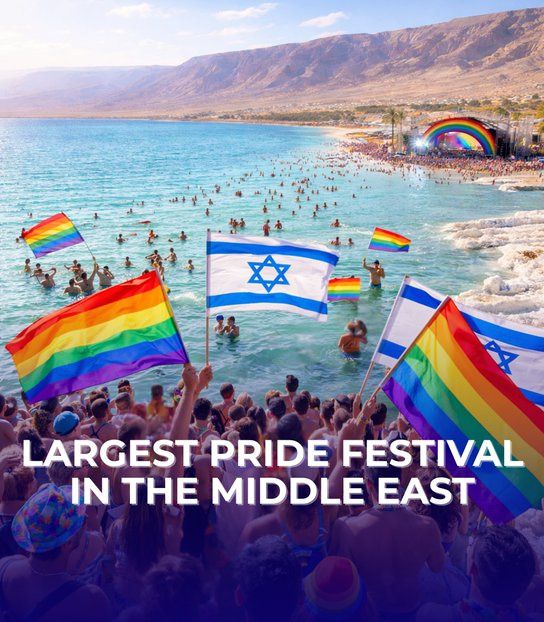
Israel is facing widespread online attention after its official government social media account promoted a large-scale LGBTQ+ festival scheduled to take place near the Dead Sea this June. The event, called "Pride Land," is being described as the largest LGBTQ+ festival ever held in the Middle East, and has quickly become the subject of global discussion.
The four-day festival is planned for June 1-4, 2026, and will transform part of the Judaean Desert into a temporary event space featuring hotels, beach access, and a central performance arena with continuous entertainment. Organizers say the goal is to create a fully immersive environment that blends music, tourism, and cultural programming.
However, it is the location of the event that has drawn the most attention. The Dead Sea region is widely associated in the Bible with the account of Sodom and Gomorrah in Genesis 19, a connection that has fueled strong reactions from some Christian commentators and public figures.
Among the responses circulating online, Father Michael Lillie, a priest in Ohio, questioned the symbolism of the location, stating, "Why here? They are mocking God." His comment was echoed by libertarian commentator Josie Glabach, who wrote, "From the ruins of Sodom and Gomorrah, we're reminded once again why pride is a deadly sin. This is a mockery of God."
Other reactions focused on broader concerns surrounding the timing and global context of the event. Conservative commentator Jack Posobiec asked, "This is going on despite war restrictions?" while BlazeTV host Auron MacIntyre questioned the role of American Christians in responding to the announcement. Evangelist Sean Feucht also weighed in, writing, "We are living in the End Times."
The festival comes as Israel continues efforts to revitalize tourism amid ongoing regional instability and international travel advisories. Officials have positioned the event as part of a broader cultural and economic initiative aimed at drawing global visitors.
For many within the Christian community, the announcement has become more than a tourism headline-it has sparked reflection on how faith intersects with modern cultural developments. As reactions continue to circulate, the conversation highlights deep differences in worldview and the ongoing tension between biblical convictions and contemporary global events.


![At The Meeting (Live) [Official Lyric Video] --- Kelontae Gavin](https://jubileecast-29b4.kxcdn.com/data/videos/thumbnail/1227/at-the-meeting-live-official-lyric-video-kelontae-gavin.jpg?w=436&h=265&l=50&t=10)


