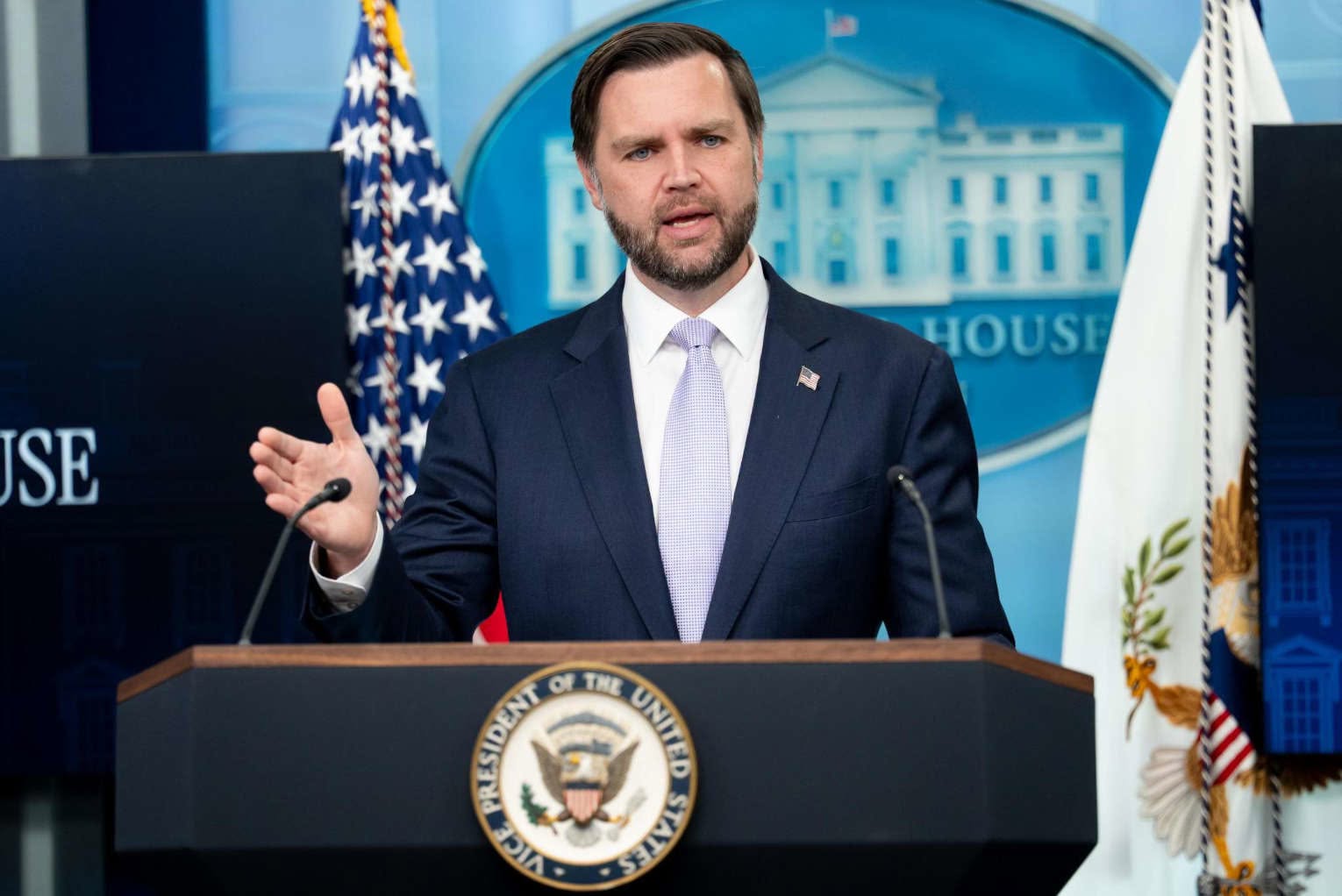
Vice President J.D. Vance has made a surprisingly candid admission about his Christian faith, revealing that he still wrestles with doubts about God-and cannot say with complete certainty that he will go to heaven.
The intensely personal confession came during Vance's appearance on Christian evangelist Bryce Crawford's podcast. Crawford, who has become known for asking prominent guests direct questions about Jesus and salvation, put the vice president on the spot with one deceptively simple question: On a scale from one to 10, how confident was he that he would go to heaven?
Vance did not offer the polished, predictable answer many might have expected from one of America's most prominent Catholic politicians. Instead, he rated his confidence at only "a seven or an eight," admitting that doubt remains part of his spiritual life.
"Oh man, that is a tough question," Vance responded. "It's high, but it's not a 10. I'm always one of these people who is always going to have little doubts."
Even more surprisingly, Vance revealed that his confidence would have been considerably lower just one year ago. At that time, he said, he probably would have rated his certainty at only "a five or a six." His admission prompted Crawford to ask what had changed.
Vance explained that his uncertainty was not primarily driven by fears that he had failed to perform enough good deeds to earn a place in heaven. Instead, the vice president admitted that he sometimes wrestles with an even more fundamental question: Is Christianity actually true?
"All respect to God, but, you know, I still occasionally have doubts," Vance said. "Like, is this actually real?"
That unusually vulnerable disclosure offered a rare glimpse behind Vance's public image. Although he is now one of the most powerful political figures in the United States, he acknowledged that status, influence and intellectual conviction have not eliminated every spiritual question.
Vance nevertheless clearly affirmed his faith in Jesus Christ, calling Jesus his Savior and expressing his desire to obey God. He said he believed he had followed what God had instructed him to do, including placing his faith in Christ and attempting to walk the path of faith.
"Believe in Jesus Christ. I believe he's my Savior," Vance said. "I try to do the things that are, you know, sort of necessary to walk the path of faith, and I think that eventually leads to heaven."
However, his repeated references to doing what is "necessary" are likely to stir theological discussion among Christians. Historic Christianity teaches that salvation is received through God's grace by faith in Jesus Christ-not earned through moral achievement or religious performance. Vance appeared to recognize that distinction, but his answer also revealed the personal tension between trusting Christ and evaluating one's own spiritual walk.
"But I'm not 100% certain," he concluded. "And I'm always going to be one of those people who has little doubts about it."
For some Christians, Vance's admission may sound unsettling, particularly when Scripture presents eternal life as something believers can know rather than merely hope to receive. For others, his honesty will be deeply relatable. Doubt has followed believers throughout Christian history, and even those with sincere faith can experience seasons of uncertainty.
Whatever one thinks of his politics, Vance's confession was unexpectedly human. When confronted with the ultimate question-where he believes he will spend eternity-the vice president abandoned political talking points and admitted that beneath the power, security and public confidence is a man still wrestling with faith, doubt and the assurance of salvation.


