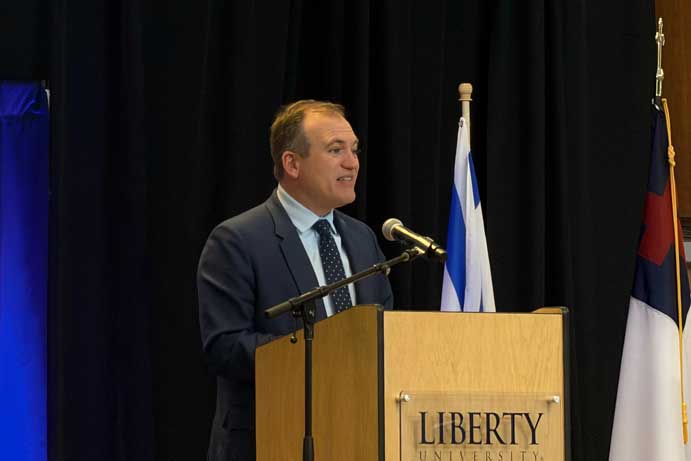
Rev. Johnnie Moore is urging Christians to examine the voices shaping their beliefs online, warning that hostility toward Jewish people can arrive dressed in biblical language. Speaking at Liberty University on Thursday, October 22, Moore challenged students to recognize antisemitism even when it comes from influential figures within their own religious and political circles.
According to ChurchLeaders, which attended the university's Center for Israel event in Lynchburg, Virginia, Moore argued that conservative Christians face a growing problem within their own communities. His warning focused on the combination of selective biblical interpretation, online influence and financial incentives that can turn prejudice into profitable content.
"This antisemitism used to come mainly from the left, but now it's coming increasingly from the right, and it is often wrapped in Bible verses taken out of context," Moore said. "It is amplified by algorithms. It's monetized online to make us fuel our outrage."
His remarks raise a searching question for Christian audiences: Does an influencer's use of Scripture make a message trustworthy, or does it make careful scrutiny more necessary? Moore's concern is that familiar religious language can give hostility an appearance of spiritual authority, encouraging listeners to accept claims they might otherwise question.
"When antisemitism hides behind a cross or addresses itself in Christian vocabulary, when it flows from the mouth of a Christian influencer, it is not just another viewpoint; it is a betrayal of the gospel itself," he said.
That description moves the issue beyond a dispute about an influencer's tone. Moore presented antisemitism expressed in Christian terms as a contradiction of the faith its promoters claim to defend. His warning asks believers to assess the substance of a message rather than rely on the speaker's reputation, political alignment or religious vocabulary.
Moore, identified in the report as the Center for Israel's senior founding fellow, also placed his argument within Liberty's longstanding support for Israel. He recalled founder Jerry Falwell Sr.'s trip to Israel with the university's inaugural class of 154 students, presenting the institution's commitment as part of its history.
He then explained the biblical basis for his own position. Beginning with God's call to Abraham in Genesis 12, Moore argued that Christian support for Israel and the Jewish people grows from promises that continue through Scripture.
"Zionism, our support of Israel and the Jewish people, is not some modern political idea that Christians decided to support. It is a biblical idea," he said.
Moore's remarks therefore bring together two connected but distinct arguments: his theological defense of Christian Zionism and his condemnation of antisemitism. Readers can examine his interpretation of the biblical promises while also confronting the obligation to reject hostility toward Jewish people. Disagreement about Israeli government policy or Christian interpretations of Israel should be assessed on its actual content; hostility toward Jews demands direct scrutiny.
The online dimension gives his warning particular relevance for students. Moore described an environment in which outrage attracts attention and can generate income, creating incentives for increasingly provocative claims. His challenge is to consider what happens when a Christian audience's anger becomes part of someone else's business model.
For churches and families, the practical application begins with the content they watch and share. Does a speaker explain a biblical passage in context? Does an argument address specific actions and policies, or assign collective blame to Jewish people? Does religious language encourage careful judgment, or provide cover for contempt?
Moore's address asks Christians to apply those questions to voices they already trust. The test he places before his audience is whether loyalty to the gospel will lead them to challenge prejudice when it comes from someone on their own side.


