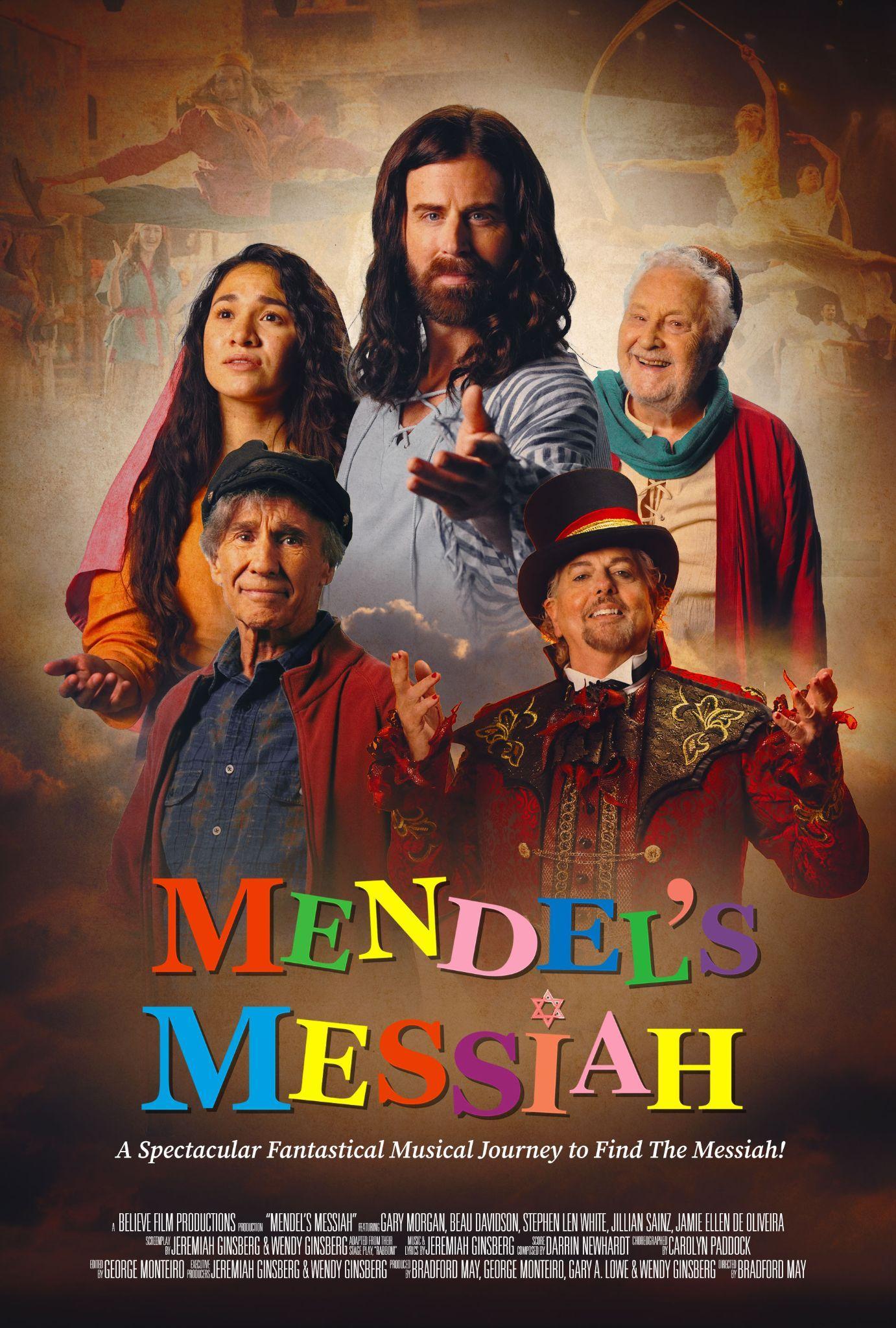
MENDEL'S MESSIAH, the award-winning Off-Broadway musical, is set to reach global audiences this spring through a new cinematic adaptation, bringing its powerful message of faith, redemption, and the revelation of the Messiah to streaming platforms worldwide. Honored with the Bronze Halo Award, the film blends Gospel music, dynamic dance, humor, and heartfelt storytelling to follow Mendel Moskowitz, a Jewish candy store owner whose life is upended by tragedy and who embarks on a supernatural journey that ultimately leads him to discover Yeshua (Jesus) as the long-awaited Messiah.
Executive produced, written, and composed by Jeremiah Ginsberg and Wendy Ginsberg, and directed by Emmy Award winner Bradford May, the film features a cast including Beau Davidson, Stephen Len White, and Gary Morgan. With its rich blend of biblical narrative and imaginative storytelling, MENDEL'S MESSIAH offers a moving portrayal of one man's journey from doubt to belief, inviting viewers to encounter the Gospel story in a fresh, vibrant, and deeply meaningful way.
We are grateful to be able to chat with Jeremiah Ginsberg for this exclusive interview.
Q: You've spent decades bringing biblical stories to life through musical theatre. What first inspired you to tell the story of Yeshua specifically through the lens of a Jewish candy store owner in Brooklyn?
I had a profound spiritual awakening in which I saw Yeshua-Jesus-face to face in a vision. At the time, I was a practicing attorney licensed in both New York and Connecticut. In the Jewish community, many people do not accept that He is the Messiah. But after that experience, and many other spiritual moments in His presence, I knew without question that He is the Messiah of Israel. No one could ever persuade me otherwise, because I saw Him with my own eyes.
That experience led me to write my first musical, Rabboni, which I produced in churches in Los Angeles. The production received a Bronze Halo Award from the Southern California Motion Picture Council. My new faith also brought conflict. Some traditional Jewish organizations tried to stop the show, but we persevered and opened Off-Broadway at the Perry Street Theater in 1985 to strong reviews.
In 1994, when the show ran in Miami, an Orthodox Jewish group picketed the production and attempted to stop Jewish audiences from entering the Colony Theater. Then in 1997, another group tried to shut down our second musical about the life of Moses simply because I was known to be a Messianic Jewish believer.
Despite those challenges, my faith remained strong. I had seen the truth for myself. I'm still the same Jewish man raised in a loving Jewish family and proud of my heritage. Writing in the voice of a Jewish candy store owner in Brooklyn came naturally to me. Some of my own relatives settled there after immigrating from Russia around the turn of the century. I remain fully Jewish-simply a Jew who believes that Yeshua is the long-awaited Jewish Messiah.
Q: Mendel's Messiah blends Gospel music, Jewish culture, humor, and supernatural elements. How did you approach balancing theological depth with entertainment in a way that speaks to both Jewish and Christian audiences?
Music has been part of my life since childhood. My father, Benjamin Ginsberg, played with the original Artie Shaw Band and later performed with the New Haven Symphony Orchestra. When I was in high school in Hamden, he encouraged me to study the stand-up bass. I fell in love with the instrument and became a classical and jazz bassist, often practicing for hours each day.
I also grew up immersed in Broadway music. My father frequently brought me to rehearsals at the Shubert Theatre where he played for developing musicals. By the time I was young, I knew many Broadway scores almost by heart. Composers like George Gershwin, Cole Porter, and Rodgers and Hart were enormous influences on me.
That background shaped how I approached my own work. I've always tried to compose with care, discipline, and respect for the craft. I admire the great classical composers and opera as well, and I've always believed music written for God deserves the very best effort. That philosophy guided how I developed the score and tone of Mendel's Messiah-blending theatrical storytelling with faith in a way that feels both heartfelt and entertaining.
Q: The story begins with tragedy and anti-Semitic violence. Why was it important for you to ground Mendel's spiritual journey in real-world pain and historical tension?
From a young age, I was deeply aware of and proud of my Jewish heritage. In many ways, Mendel's story mirrors my own search for God's truth. Even while I was working as a successful attorney, I continued asking those spiritual questions.
As a child growing up in the shadow of the Holocaust, I didn't experience its horrors firsthand, but its memory left a lasting impact on me. The history and suffering of the Jewish people shaped my identity and my faith. When I see the flag of Israel with the Star of David, it still fills me with pride.
I love my people deeply. At times it has been painful when others reject the belief that means so much to me, but that doesn't change my connection to them. They are my people and always will be. My faith in Yeshua as the Jewish Messiah has never diminished my love for the Jewish community or my commitment to stand with Israel and its people.
Q: You've described John 3:16 as the greatest love story ever told. How does this cinematic adaptation expand that message beyond what audiences experienced in the Off-Broadway stage production?
Over the years, the story evolved into something much larger than the original stage production. As the director of the show, I always imagined expanding the colors, imagery, and themes of the story. I've never been someone who easily feels satisfied with past accomplishments-I'm always looking for ways to deepen and improve the work.
My wife, Wendy, has been an essential partner in that creative process. She is a remarkable writer and has stood beside me for 43 wonderful years. Together we've faced many creative and production challenges, but we've always pushed forward because of our shared dedication to the project and to each other.
When I feel exhausted or stuck, Wendy keeps the momentum going. Her optimism and determination are extraordinary. Over the years we've also built an incredible extended family of performers, designers, and creative collaborators who have helped bring the project to life. Wendy also has a remarkable ability to catch every mistake I make, which has been invaluable.
Q: After winning the Bronze Halo Award, what does it mean to now bring Mendel's Messiah to global streaming platforms through FaithChannel?
Winning the Bronze Halo Award from the Southern California Motion Picture Council was deeply gratifying. I never expected my work would reach that kind of recognition. I've never thought of myself as someone destined for prominence, so each success has always come as a surprise.
At the same time, I've always believed that the credit ultimately belongs to God. He is the Creator of the universe, and I'm simply someone fortunate enough to have been given opportunities to create.
Prayer has always been central in my life. When challenges arise, I pray and wait for guidance. Sometimes blessings come quickly, and sometimes they take time. Either way, I try to receive everything with gratitude.
One of those blessings was connecting with director Bradford May, an Emmy Award-winning filmmaker whose talent has elevated the project tremendously. His creative vision has helped bring Mendel's Messiah to life on screen in a powerful way. And partnering with FaithChannel has allowed the film to reach audiences around the world.
Q: For viewers who may be skeptical, hurting, or questioning God-much like Mendel at the beginning-what do you hope they experience by the final scene of the film?
Over the years we've written and produced five musicals in cities including New York, Los Angeles, Washington, D.C., and Florida. I rarely revisit those productions more than once or twice. But Mendel's Messiah is different-I've watched it many times because it represents the most complete realization of the vision we've been working toward for decades.
At its heart, the story is about love-the love poured out on humanity by the greatest man who ever lived. Whether someone approaches the film with faith, skepticism, or personal pain, my hope is that they encounter that message of love.
Ultimately, I hope viewers leave the film feeling moved, inspired, and perhaps even surprised by how powerfully the story resonates with them.
For more information, visit mendelsmessiah.com, https://www.facebook.com/mendelsmessiahmovie.


