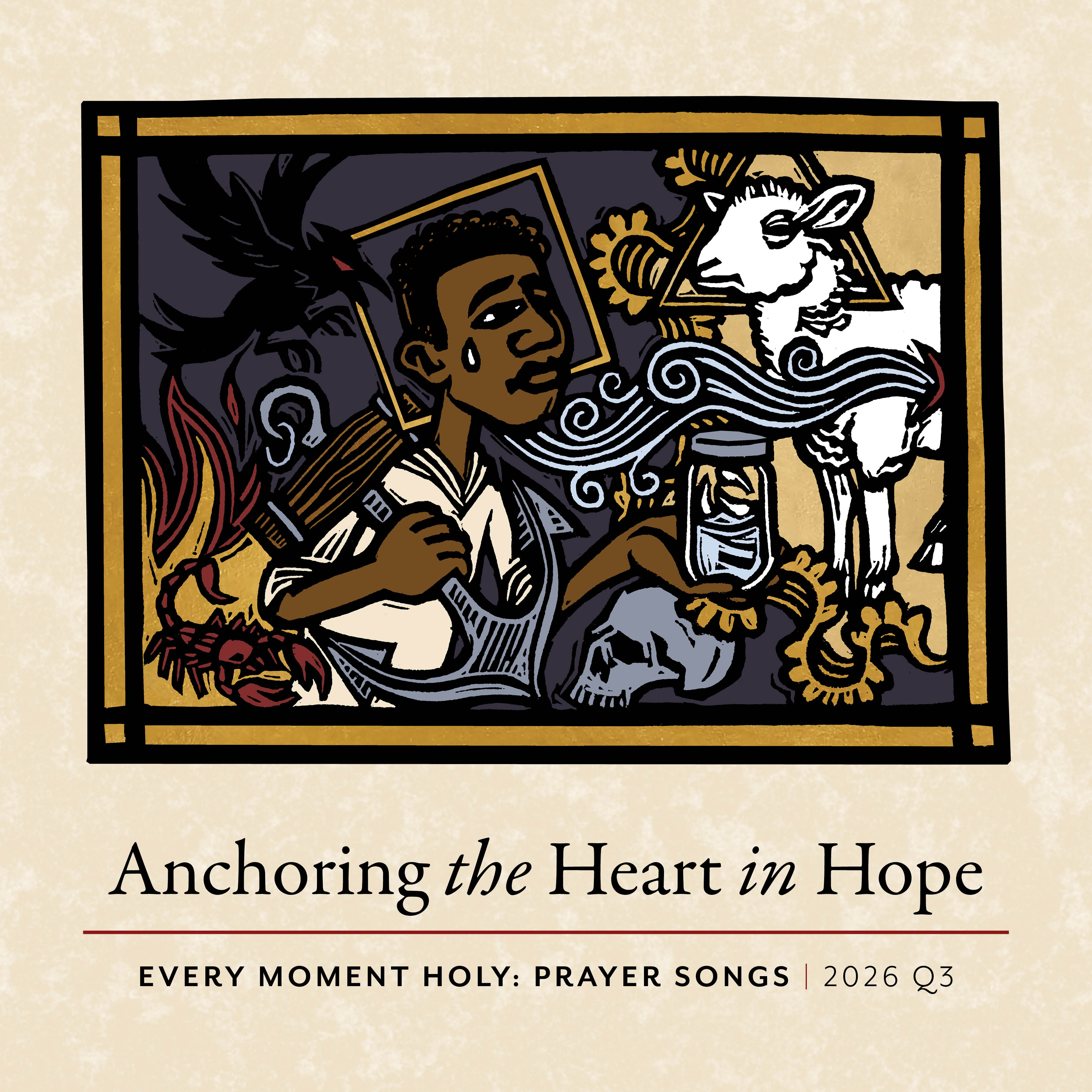
How do you create songs for those approaching the end of life without minimizing the reality of death or surrendering Christian hope? Author and songwriter Douglas Kaine McKelvey and Unspoken's Jon Lowry confront that profound challenge on Anchoring the Heart in Hope. The 14-song collection transforms prayers from Every Moment Holy: Death, Grief & Hope into contemplative, seamlessly loopable songs intended for the dying, their loved ones, hospice workers, and anyone walking through loss. In this in-depth interview, McKelvey and Lowry discuss their 17-year creative partnership, the album's unusual musical structure, and their desire to help grieving hearts look toward resurrection and the promised joys of the New Creation.
Q: Douglas and Jon, before we discuss the new album, how did your creative partnership begin?
Douglas: 17 years ago, Jon's band Unspoken won a contest. The prize was a development deal with a record label, so they subsequently moved from Maine to Nashville to chase down that opportunity. The label set up songwriting sessions for them with numerous writers in town. I was signed to Simpleville Music at the time, and happened to be one of the first co-writes for the Unspoken guys.
Sometimes during a session you pretty quickly realize you're on a complementary creative wavelength with another writer. There were four of us in that initial session, but something clicked between Jon and myself, and we both recognized it. The quick version of that story is that he has been my primary songwriting partner ever since. Back then, Jon was a single bachelor with a motorcycle disassembled in his apartment kitchen. I was sixteen years ahead of Jon in age and in terms of major life events, so my wife and I kind of adopted him. We'd have him over once a week for a home-cooked meal, and in return he'd give our daughters guitar lessons. So we quickly became friends as well as creative collaborators.
Q: And what led you to transform the Every Moment Holy liturgies into prayer songs?
Douglas: During the year I spent writing the first volume of Every Moment Holy liturgies, from 2016-2017, I already had a sense that some musical interpretation of the prayers might make sense-but I couldn't quite define what that might be. I approach creative projects from the standpoint of recognizing and naming a need that's not already being met, and then figuring out how to meet it.
After the first couple books were published and selling well, I had some conversations with one of the Christian record labels about possibly making an Every Moment Holy album with them, but none of us could define what need existed that might be filled by a musical expression of Every Moment Holy prayers, and so it didn't go anywhere.
Around eight years after the first book had released though, Jon had come over one evening to hang out and play a board game-but we both felt a little too restless to settle into a game, so we picked up guitars and started messing around with song ideas instead. I played Jon a snippet I had come up with a few weeks earlier. There was a one-sentence prayer I had penned for the EMH: Rites of Passage book I was working on at the time, and I had already set that to a melody, thinking it might make a nice song chorus. So we played around with that for awhile without making any headway, and then both arrived at the same strange conclusion: Maybe this is all the song wants to be. Maybe rather than a typical verse-chorus-verse-chorus-bridge-chorus structure, this is something completely different-an aid to meditative prayer such that one thought is voiced over and over, and musical space is given to meditate on that particular heart cry. And what if the track is seamlessly loopable such that a person could set it on repeat and remain in that prayerful space for however long they desire?
So the idea for what these prayers might be, and the need they might fill, arrived all at once. We immediately wrote a second prayer song together that night, and the next day Jon recorded them and sent me the tracks. I tried looping them for ten minutes or so each, and joining my heart to those prayers, and the experience was powerful. From that point we were off and running, and so far this year we've released more than forty songs across three albums.
Q: Anchoring the Heart in Hope is the first release in the series devoted entirely to one subject. Why did you choose to explore death, grief, and eternal hope across this 14-song collection?
Douglas: The second volume of Every Moment Holy prayers is subtitled "Death, Grief, & Hope". The first half of that collection is prayers to comfort and encourage those who are in the season of their dying, prayers that exist in that tension between the sorrow of mortal frailty and the hope of eternal joy. The third Prayer Song we composed happened to be taken from a twelve-part prayer in Vol 2, titled "Meditations for Anchoring the Heart in Eternal Hope". There was a real emotional power to that heart cry that Jon set to music:
Convince me, O Spirit of the Living Christ, Convince me that my hopes have been well placed!
After Jon wrote a second song from one of those meditations we thought, "Oh! This could be something. We could actually create a whole song-cycle based on these twelve meditations for anchoring the heart in hope, and we could create it with the intention of serving people in their last months, weeks, days, and hours. We embraced the idea of offering to fellow pilgrims something that might be a source of beauty and of hope and encouragement and comfort, an ongoing reorientation of the heart toward the Christ in whose presence they will soon stand, and toward the Eternal Kingdom for which they have always longed.
Q: These songs are intended particularly for people nearing the end of life, their loved ones, and those working in hospice ministry. How did you write honestly about death while ensuring that the music still communicates comfort and Christian hope?
Douglas: I spent two years penning that book of prayers for the dying and the grieving, and the working subtitle during much of that span was "Death & Grief". But at a certain point I contacted the publisher and said "I think the subtitle has to be 'Death, Grief, & Hope.' Because what I'm finding is that no matter what sorrow-filled subject I might be wrestling with in a given prayer, inevitably the hope of Jesus, of the resurrection, of the promise of the new creation and the marriage supper of the Lamb, works its way out of the shadows and the suffering, and reinterprets our very grief."
In 1 Thessalonians Paul expresses his desire that we not "grieve as those who have no hope". He doesn't tell us we shouldn't grieve when those we love die. But he tells us our grief should be leavened with and one day subverted entirely by this eternal hope. And in wrestling with death and loss and grief, I've found that to be so foundationally true. When you grapple honestly, as the psalmists did, with the depth of your loss, your fear, your disappointment, your sorrow, and your grief, that hope inevitably arises, and suffuses your sorrow with the light of something eternal.
So I think the truth of the matter is that the only way to ensure that we might offer real comfort and hope is by approaching the grief head-on, with honesty and without pre-conceived and tidy answers. Because ultimately what any of us need in those darkest places is to encounter the actual presence of God, and that's not an outcome that can be manufactured. All we can do is create a space that might be conducive to a heart pouring itself out to its Creator.
Q: Douglas, what challenges arise when adapting prayers originally written to be read into lyrics that must be sung?
Douglas: The biggest challenge I find in any ongoing project that has multiple phases, is to resist the temptation to settle into a formula at some point, to say, well this thing we stumbled on worked so let's now make that our model and force everything into that mold.
The movement of the Kingdom of God in general doesn't work that way. The Spirit of God can't be forced, or formularized, or put in a box. The real adventure of creative work is in not knowing what form a thing will take, of remaining open and being willing to be surprised; of remaining in the moment as you're creating, rather than trying to run ahead and guess the best outcome and then retrofit your work into that.
So that's certainly a challenge with this project. At first we stumbled backward into this unusual song-form of short, loopable, aids to meditative prayer, for use by individuals. But then we were working on a couple that we realized could also make sense as choruses for corporate worship. And then another that seemed perfect for an Easter service. And then one that seemed like it wanted to be a communion song. And so on. Some of the songs have been created by taking the full text of a short prayer and setting it to music. A Liturgy for Morning Coffee would be a good example of that. But other prayer songs naturally wanted to rhyme at the end of lines, so we took liberty with rewriting words or phrases from the books, in order to make a more beautiful and useful translation of the prayer to song form.
We also didn't want to rule out a more standard song form if that's what might best suit a given prayer. All Will Be Well (which is drawn from A Liturgy for Feasting with Friends) went that direction when, as we were writing it, we realized churches would probably use it as an upbeat, celebrative, communion song. So we leaned into that possibility as we finished writing that one.
I think the tendency of most human brains is to analyze for efficiency and codify whatever has worked best and turn it into a production line or an algorithm that can churn out the useful product. But ultimately that will lose the spark of life and become formulaic. So far I think Jon and I have done well at approaching each song idea with the question: What is the best form, the ideal form, for this particular prayer? We've managed to resist that "hardening of the categories" that would threaten the heart of the project.
Q: And how closely do the songs follow the prayer cycle in Every Moment Holy: Death, Grief & Hope?
Douglas: For the most recent "Anchoring the Heart in Hope" album, we lifted what we thought were the most representative lines from each of the twelve meditative prayers in that cycle. The prayers in the book are considerably longer, ranging from one to five paragraphs, but we tried to find the lines that distilled the heart of each into a singable form. We made a few tweaks here and there to those lines. For instance, the word yearning in the line Send the winds of Your Spirit. Awaken my homesick heart. I am yearning for my home, didn't sing quite right, so we changed yearning to longing. Those minor artistic adjustments aside though, our goal was that the movement across the twelve songs would be, emotionally and spiritually, the same journey found in the text.
As a side note, early on in the development of this song cycle we had the idea to create an extended version of the project that would feature a spoken-word artist doing readings of the full text of each of the meditations over extended, instrumental sections in the middle of the songs. For some reason the potential readers we identified all lived in the UK, so it took us months to finally get one of them across the Atlantic and into Jon's studio. But we've now recorded Welsh poet and spoken word artist, Dai Woolridge, delivering all those pieces, and his interpretations were just amazing. We're excited to release that extended version of the project sometime in 2027.
Q: Jon, how did you develop a cohesive musical journey across the album, and why was it important to make each song seamlessly loopable for personal prayer and contemplation?
Jon: Because the previous releases of prayer songs covered such a wide range of topics it was important for me to make each one seamlessly loopable so that someone could put a track on repeat and stay in that place of prayerful meditation on a topic for as long as they wanted. But since this cycle of songs focuses on one specific topic, while still being loopable, I was more concerned with the musical journey from song to song being seamless.
Since this album is based on a beautiful twelve-part prayer that Doug wrote for the Death Grief and Hope volume, I had the idea early on that each song should be written in a different musical key so that by the end we would have traveled around the circle of fifths and played in all twelve keys of western music. I also wanted to work pieces of all the previous eleven songs back into the last one so that even the sorrow in some of those earlier pieces is suddenly turned to joy as the full implication of those truths is seen in the light of the truth that "This is not the end". I wanted the music to be the same journey and capture the same images that Doug's lyrics so beautifully spark in our imaginations. It is well accepted scientifically that hearing is the last of our senses to be lost in death, so it is humbling to think that this album might be an aid in shepherding people at the end of their lives into the eternal presence of their Creator. Even though I have heard all of these songs hundreds of times now I still can't get through the end of the album without getting goosebumps as I imagine myself at the wedding supper of the Lamb, reunited with those I love and looking up over the table at the beauty of the new creation. In some ways I don't even feel like this album was something I created because it's part of the biggest, truest story and I am just grateful to be welcomed into the telling of it.
Q: What do you hope listeners will experience through Anchoring the Heart in Hope, and how will the forthcoming Every Moment Holy: The Live Experience deepen the album's themes of loss, remembrance, and divine redemption.
Douglas: That's an interesting question because the narrative arc of the two-hour, live event we're now in the midst of touring, runs very much in parallel to the journey through loss and grief, and to a renewed, eternal hope and joy that sits at the heart of the songs. That wasn't something I set out to mirror when I was creating the content for the live event, but it emerged organically in both projects. I guess it's just a message that's essential to my own life, so it's naturally going to find its way into various things I create. The live event involves songs from multiple artists, prayers from the books, personal narrative storytelling, and several of the Every Moment Holy: Prayer Songs (including one from the new project) which are sung congregationally in that live setting.
So both in the live setting and through the Anchoring the Heart in Hope album, our hope is that those who experience them will find spaces created in which they can name their disappointment, loss, and grief, and in the very midst of those sorrows find that there is indeed an eternal comfort, an eternal hope, an Eternal God who cradles them, comforts them, and shepherds them-even through the valley of the shadow of death-toward the promised joys of the New Creation.
The quarterly Every Moment Holy: Prayer Songs releases are available on all major streaming platforms. For further information, visit emhsongs.com or turningpointpr.com. Follow the series on Instagram and Facebook.


