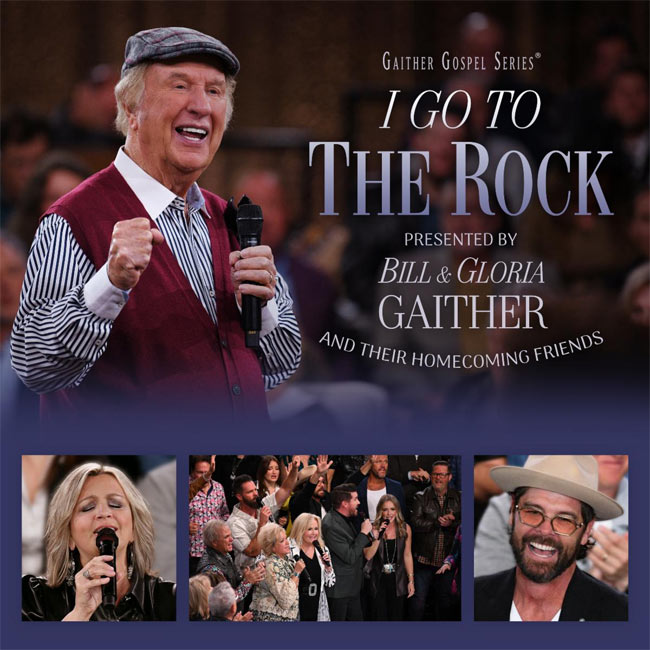
Prime Cuts: "I Wouldn't Take Nothing For My Journey" (feat. Mark Trammell, Roland Kesterson, Angela Primm, Joyce Martin Sanders, and Libbi Perry), "Bread Upon The Water" (feat. Marshall Hall, Michael Booth, Ernie Haase, Dustin Doyle, Ronnie Booth, and Wes Hampton), "Love In Any Language" (feat. Sandi Patty, Don Peslis, Reggie & Ladye Love Smith, and Wes Hampton)
Overall Grade: 4/5
Bill Gaither and Gaither Music Group deliver exactly what listeners have come to expect with I Go to the Rock, and in many ways, that familiarity is the album's greatest strength. Recorded during a massive Homecoming gathering of more than 250 artists, the project feels less like a studio album and more like a communal worship experience captured in real time. It is expansive, celebratory, and deeply rooted in the traditions that have sustained gospel music for generations.
Everything you expect from a Gaither release is present here: hymns, contemporary Christian favorites, audience participation, and a lineup that reads like a who's who of gospel music. The atmosphere is warm and inclusive, built not on musical experimentation but on shared memory and collective praise. From the outset, the album invites listeners not just to hear the songs, but to join in them.
The classics are where the album truly shines. "I Wouldn't Take Nothing For My Journey" carries the unmistakable spirit of southern gospel, delivered with conviction and joy by a seasoned ensemble of voices. "Bread Upon The Water" leans into a large-scale, singalong dynamic, stacking harmonies in a way that feels both grand and accessible. Meanwhile, "Love In Any Language" allows Sandi Patty to revisit one of her most beloved songs with a performance that is both controlled and deeply expressive, reminding listeners why the song has endured.
The album also balances its reverence for the past with touches of the present. Songs like Karen Peck and New River's "I Speak Jesus" sit comfortably alongside timeless hymns such as "There's Something About That Name," performed by the Gaither Vocal Band and Gloria Gaither. A rousing version of "Majesty" further highlights the participatory nature of the recording, with the audience fully engaged, reinforcing the sense that this is as much a gathered worship moment as it is a musical production.
What ultimately defines I Go to the Rock is its sense of community. The presence of hundreds of voices-both on stage and in the audience-creates a layered, immersive sound that elevates even the simplest arrangements. There is a palpable joy throughout the recording, a reminder that gospel music, at its core, is meant to be shared.
If there is a weakness, it lies in the album's predictability. The arrangements rarely venture beyond familiar territory, and those hoping for more imaginative reinterpretations may find the project somewhat safe. Even moments with clear potential, such as Sonya Isaacs Yeary's "Amazing Grace," feel restrained, where a more adventurous approach could have added a fresh dimension.
Yet, innovation does not seem to be the goal. Instead, I Go to the Rock succeeds by reaffirming what has always made the Gaither Homecoming series resonate: timeless songs, powerful voices, and a deep sense of fellowship. It preserves rather than reinvents, and in doing so, it delivers an experience that feels both comforting and enduring.


