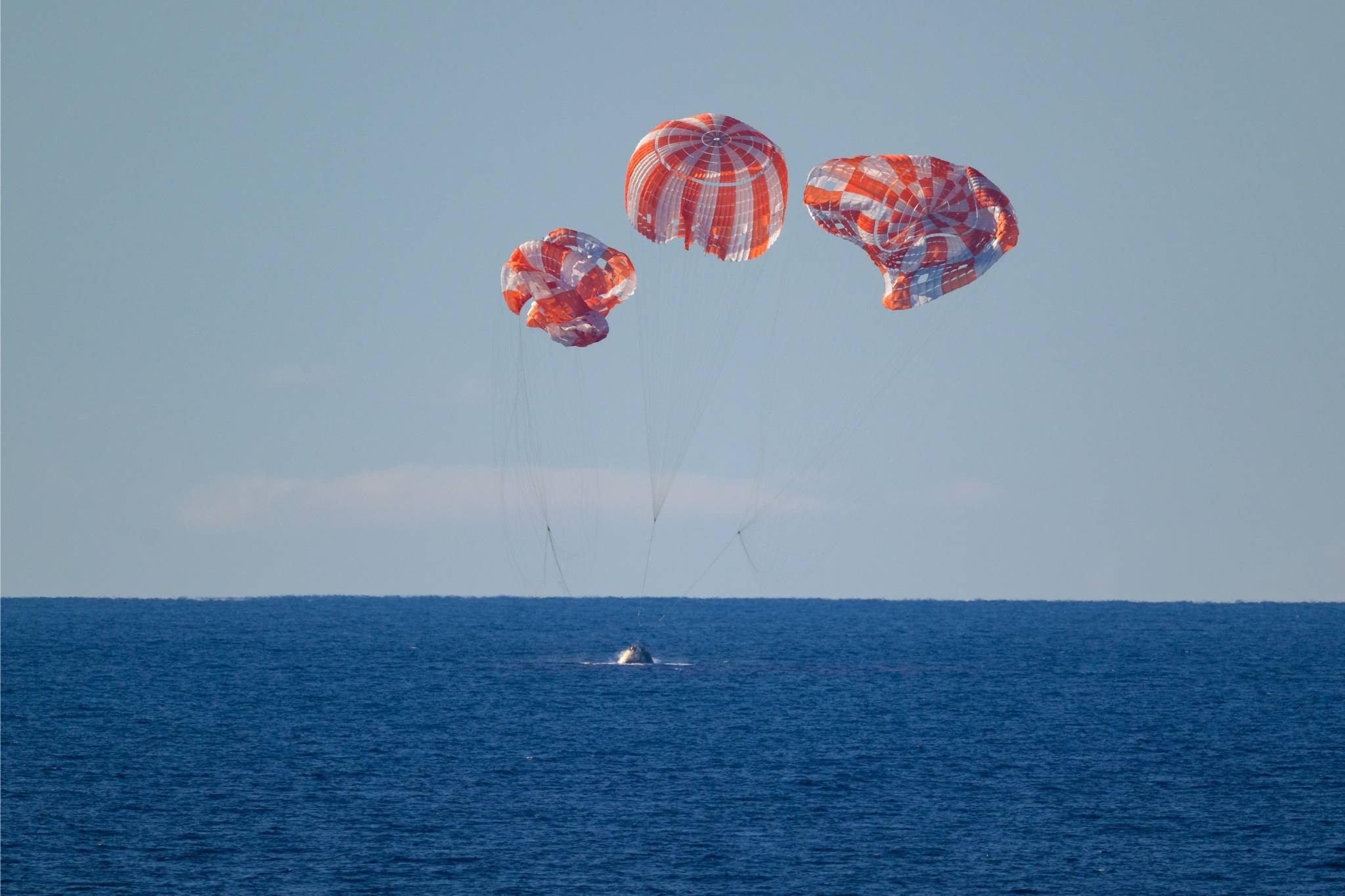
For all the milestones achieved during NASA's historic lunar mission, the most intense moment of Artemis II didn't happen near the Moon-it happened just minutes before the astronauts returned home. As the Orion spacecraft re-entered Earth's atmosphere, the crew faced a six-minute communications blackout, a critical window where contact with mission control was completely lost.
For those watching around the world, it was a moment filled with tension. For the astronauts onboard, it was a test of training, courage-and for many, faith.
The Six Minutes That Held the World Still
As Orion hurtled toward Earth at speeds reaching 25,000 miles per hour, the spacecraft encountered extreme heat and pressure during re-entry. This created a plasma sheath around the capsule, temporarily blocking all communication signals between the crew and NASA's ground teams.
During this six-minute blackout, no one on Earth could hear or see what was happening inside the spacecraft.
It's a standard part of re-entry-but that doesn't make it any less nerve-wracking.
Space educator Pam Leestma described the moment simply:
"I was praying real hard and holding my breath... just trusting that everything was going right."
That sentiment was shared by millions around the globe who followed the mission closely.
Trusting the Mission-and Something Greater
Inside the capsule, astronauts Reid Wiseman, Victor Glover, Christina Koch, and Jeremy Hansen had no choice but to rely on their training and the systems around them. Every movement, every calculation had been rehearsed-but in those silent minutes, there's no real-time reassurance from Earth.
For Victor Glover, whose expressions of faith have been widely noted throughout the mission, moments like these carry deeper meaning. While specific words from inside the blackout remain unknown, his past reflections suggest a mindset rooted in trust beyond circumstance.
That perspective resonates strongly with many who followed the journey-not just as a scientific achievement, but as a reminder of the human spirit under pressure.
A Perfect Re-Entry After Total Silence
Then, just as suddenly as it began, communication was restored.
Signals returned. Data flowed again. And soon after, Orion deployed its parachutes, slowing its descent before making a precise splashdown in the Pacific Ocean near San Diego at 5:07 p.m. PDT on April 10, 2026.
NASA later confirmed the landing was a "textbook touchdown," with the capsule arriving within a mile of its intended target. Recovery teams quickly reached the crew, who were reported to be "happy and healthy."
The silence had ended-but the impact of those six minutes lingered.
Why This Moment Defines Artemis II
While the Artemis II mission will be remembered for its record-breaking distance and historic lunar flyby, the re-entry blackout stands out as its most human moment.
It's where advanced technology meets vulnerability. Where precision engineering meets uncertainty. And where, for many, faith meets fear.
In a world driven by constant communication and control, those six minutes were a rare reminder: sometimes, the most critical moments happen when we have to let go and trust.
For believers, it echoes a timeless truth-that even in silence, even in uncertainty, we are not without guidance.
Looking Ahead with Renewed Confidence
With Artemis II safely completed, NASA now looks toward future missions, including a planned return to the Moon's surface. The success of this re-entry phase-arguably one of the most dangerous parts of space travel-builds confidence for what lies ahead.
But beyond the data and the milestones, it's moments like the six-minute blackout that stay with people.
Because in those silent minutes, suspended between space and Earth, the Artemis II crew didn't just make history-they reminded the world what it means to trust, endure, and come home.


