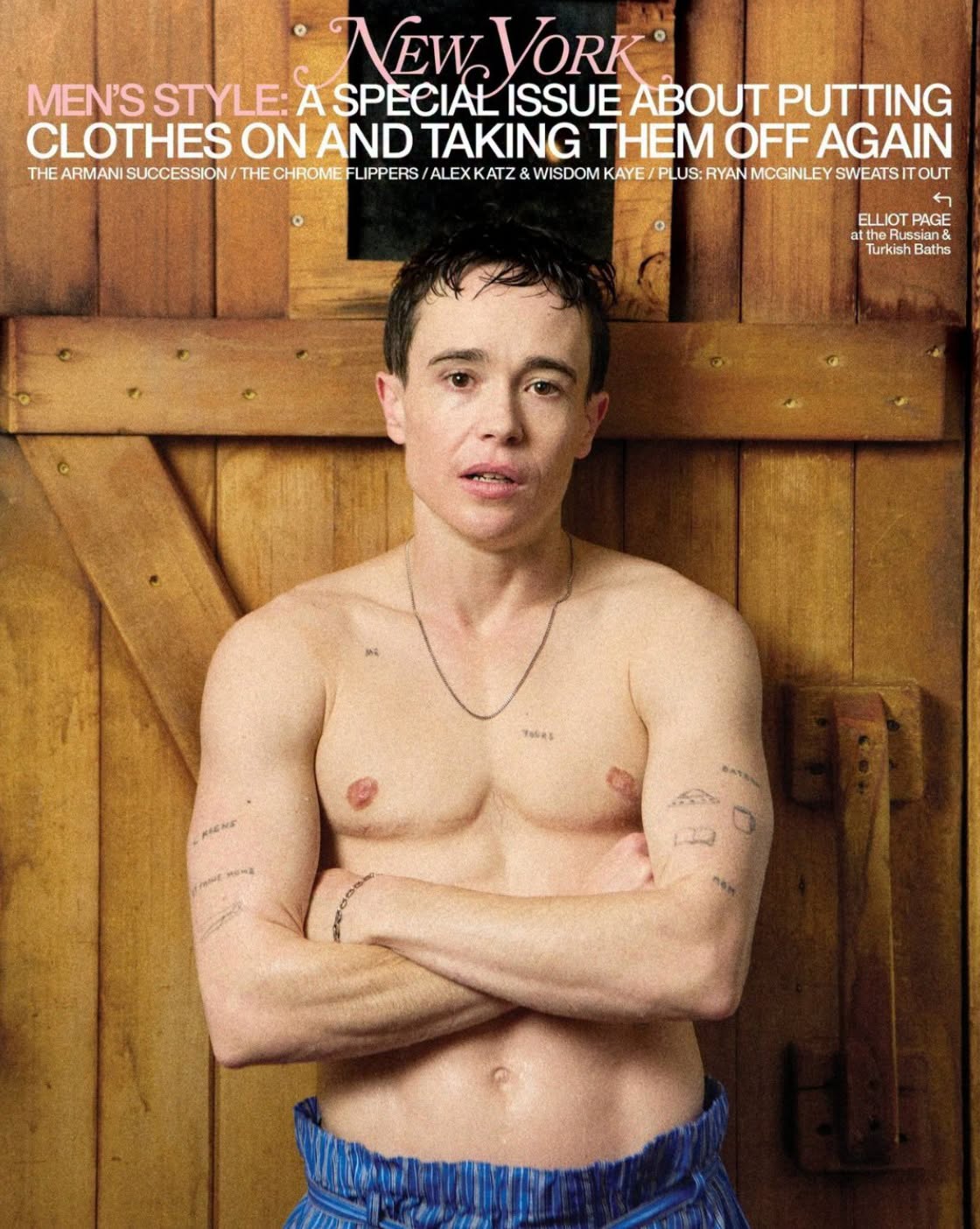
New York magazine's first standalone Men's Style issue features transgender actor Elliot Page on one of its covers, bringing questions about gender and representation into a publication devoted to men's fashion. For Christians who understand male and female as distinctions rooted in creation, the editorial choice raises a question that extends beyond celebrity: How should believers respond when mainstream culture presents a different understanding of what makes someone a man?
The cover photograph shows Page shirtless, leaning against a wooden doorway with tattooed arms crossed. It accompanies a bathhouse feature, giving the issue a focus on bodies as well as clothing. The magazine introduced the edition with the subtitle "A Special Issue About Putting Clothes On and Taking Them Off Again."
Photographer Ryan McGinley's accompanying portfolio, "The Boys in the Baths," was shot at Manhattan's Russian & Turkish Baths. The feature places familiar cultural figures within a historic communal setting, making physical appearance and public identity central to its presentation.
For supporters of transgender inclusion, featuring Page in a men's issue can represent recognition and belonging. Christians who hold a traditional understanding of biological sex may interpret the same choice as an endorsement of a view they cannot affirm. That disagreement concerns the relationship between the body and personal identity, rather than simply whether a photograph belongs on a fashion cover.
A traditional Christian reading begins with Genesis 1:27, which describes humanity as created in God's image, male and female. Within that understanding, the body has significance that precedes individual preference or public recognition. Sex is part of the created person, and changing cultural categories does not settle the theological question of what the body means.
The same verse also places human dignity at the center of the discussion. Bearing God's image cannot become a principle Christians invoke for themselves while overlooking it in someone whose beliefs or choices they dispute. A Christian response therefore needs to explain its convictions without turning Page's appearance into an opportunity for ridicule.
That requirement makes the conversation more demanding than an angry headline. Readers deserve a clear account of why Christians regard sexual difference as meaningful, how that conviction relates to identity, and what respectful disagreement looks like in practice. Mockery supplies none of those answers and can obscure the argument believers want others to hear.
The editorial decision also invites scrutiny of how magazines shape cultural expectations. A cover does more than advertise the articles inside: It selects a person to represent a category. Placing Page on a men's cover treats transgender identity as belonging within that category, whether or not readers share the underlying understanding of gender.
Christians can question that framing while being careful about claims concerning the editors' motives. The cover establishes whom the magazine chose to feature; it does not, by itself, demonstrate an intention to attack Christianity. Criticism becomes more credible when it addresses the actual editorial choice and its implications.
For churches, the useful response reaches beyond reacting to a celebrity photograph. Parents, pastors, and youth leaders need language that explains Christian beliefs about the body while allowing sincere questions about discomfort, identity, and belonging. People wrestling with those questions should be able to expect patient listening alongside an honest account of the church's convictions.
Page's cover gives Christian readers an occasion to examine both what they believe and how they express it. The challenge is to make a reasoned case for the significance of male and female while treating the person at the center of the story with the dignity that Christian teaching requires.


