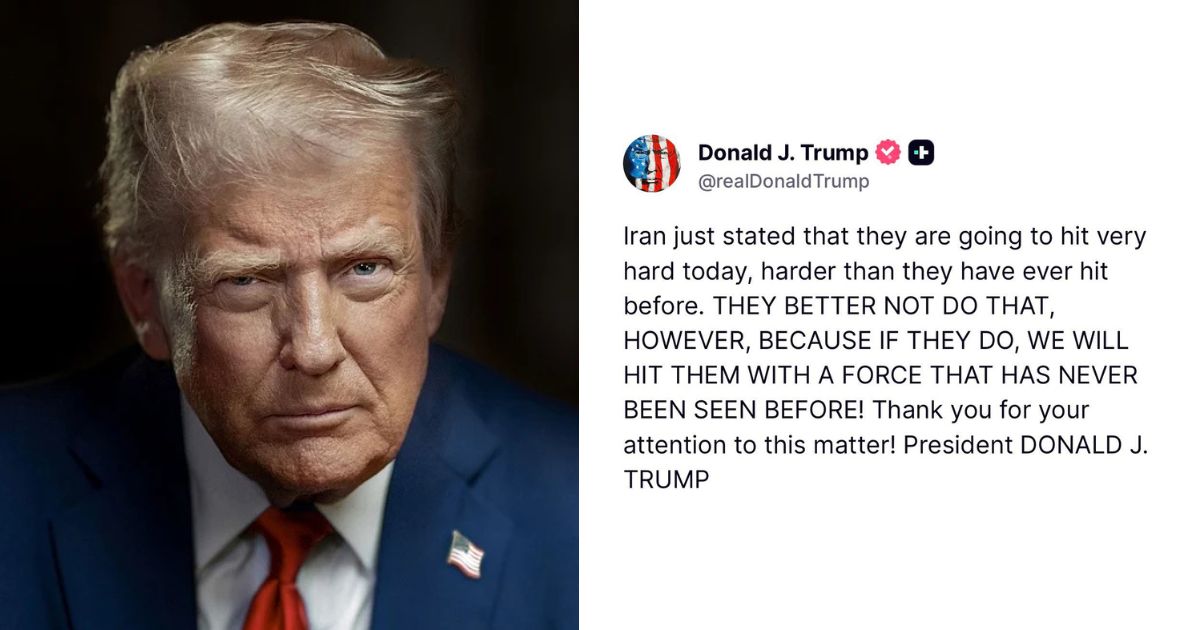
President Donald Trump has issued a strong and direct warning to Iran following Tehran's official statement confirming the death of Supreme Leader Ayatollah Ali Khamenei in U.S.-Israeli strikes.
After Iran vowed that Khamenei's killing "will not go unanswered" and promised that those responsible would "pay a heavy price," Trump responded publicly on his social media platform with a message that immediately intensified global attention.
"Iran just stated that they are going to hit very hard today, harder than they have ever hit before," Trump wrote. "THEY BETTER NOT DO THAT, HOWEVER, BECAUSE IF THEY DO, WE WILL HIT THEM WITH A FORCE THAT HAS NEVER BEEN SEEN BEFORE!"
The message underscores the escalating rhetoric between Washington and Tehran at one of the most volatile moments in recent Middle Eastern history.
Iran's Statement After Khamenei's Death
Earlier, the Iranian government confirmed that Ayatollah Ali Khamenei was killed in coordinated U.S.-Israeli attacks. In its official statement, Tehran described him as "martyred" and declared a 40-day period of national mourning, along with a seven-day suspension of public institutions.
Iranian authorities vowed retaliation, calling the strike a "great crime" that would not go unanswered. Leadership duties were temporarily transferred to President Masoud Pezeshkian, the head of the judiciary, and a jurist from the Guardian Council.
The statement emphasized national unity and pledged that Iran would respond with "full strength and resolve."
Trump's Warning Signals Potential Escalation
Trump's response appears to directly address Iran's threat of retaliation. His warning that the United States would respond with unprecedented force if Iran strikes again signals that Washington is prepared for further confrontation.
Earlier, Trump confirmed that the U.S. had launched "major combat operations" in Iran, describing the campaign as necessary to eliminate nuclear and missile threats. The operation, conducted in coordination with Israel, targeted key military and leadership infrastructure.
With Iran promising consequences and the U.S. pledging overwhelming response, the exchange of statements has heightened fears that the conflict could expand rapidly.
Regional and Global Reaction
Following the confirmation of Khamenei's death, tensions have surged across the Middle East. Missile activity has been reported in multiple areas, and U.S. military bases in the Gulf region remain on high alert.
International leaders have urged restraint, warning that continued escalation could destabilize global security and energy markets. Humanitarian organizations have also expressed concern over civilian casualties reported inside Iran.
Oil prices remain volatile as investors assess the risk of further disruption in a region critical to global energy supply.
A Defining Moment in the Conflict
The death of Ayatollah Ali Khamenei marks a historic shift in Iran's leadership during an active military confrontation. His decades-long role as the Islamic Republic's ultimate authority means his absence carries both political and symbolic weight.
President Trump's latest statement adds another layer of uncertainty. With Iran declaring mourning and promising revenge, and the United States signaling readiness to respond with unmatched force, the coming days will likely determine whether this crisis intensifies or moves toward containment.
Faith leaders and global communities continue calling for peace and protection of civilians as the world watches events unfold in real time.
Relataed Article: After Ayatollah Ali Khamenei's Death, Iran Vows Revenge and Declares 40 Days of Mourning


