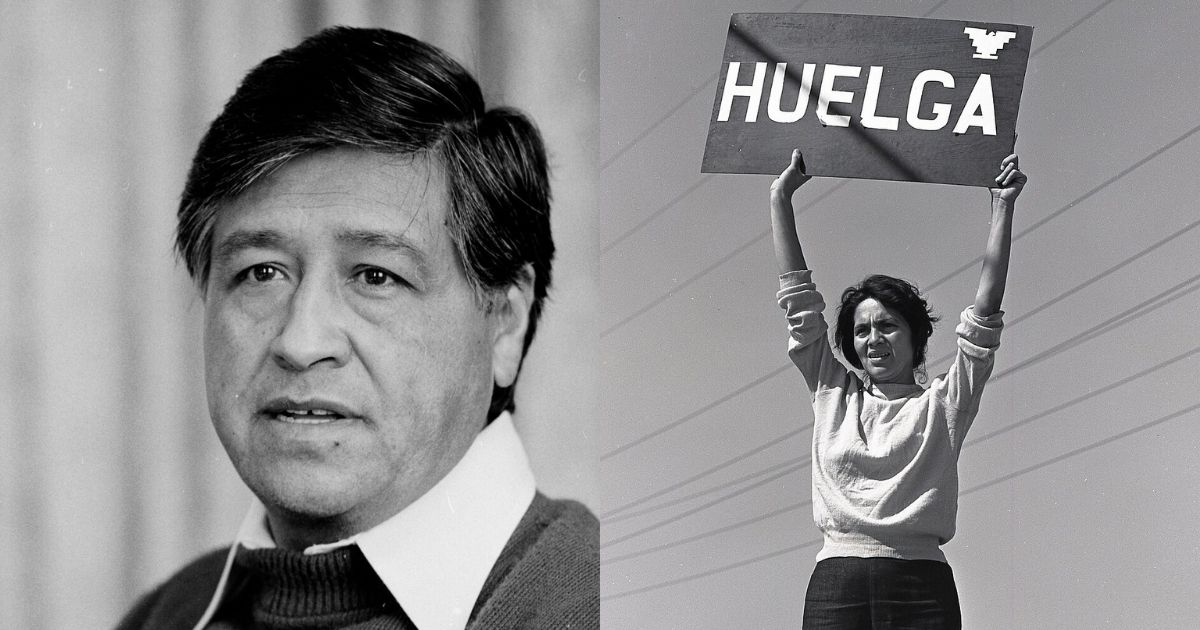
If you have seen the names Cesar Chavez and Dolores Huerta trending everywhere today and are not sure why, here is everything you need to know - and why it matters far beyond politics or labor history.
Who Is Cesar Chavez?
Cesar Chavez was one of the most celebrated Latino civil rights leaders in American history. Born in Yuma, Arizona in 1927, he co-founded the National Farm Workers Association alongside Dolores Huerta, which eventually became the United Farm Workers - the union that fought for decades to improve wages, working conditions and basic human dignity for agricultural laborers across the United States. He died in 1993 at the age of 66.
For generations, Chavez was revered as a moral giant. His worldview combined left-wing politics with Catholic social teachings, and he imbued his campaigns with Roman Catholic symbolism - public processions, Masses, and fasts - drawing inspiration from Mahatma Gandhi's philosophy of nonviolent resistance. His birthday, March 31, became a federal commemorative holiday. Several states, including California, Colorado, Texas, Minnesota, Utah and Washington, recognize a day on or near his birthday as an annual state holiday. Streets, schools, parks, and public squares across the country bear his name.
Who Is Dolores Huerta?
Dolores Huerta co-founded the United Farm Workers alongside Chavez and popularized the now-famous rallying cry "Sí, se puede" - Yes, we can - which later became the backbone of Barack Obama's 2008 presidential campaign. Now 95 years old, she is widely regarded as one of the most important women in American labor history, often called the Grandmother of the Resistance. Her portrait hangs in American embassies. She has been a towering figure in Democratic politics for six decades.
She and Chavez were, for most of the world, inseparable symbols of the same movement - two people who built something historic together.
That image shattered this week.
What Happened This Week
A New York Times investigation published on March 18, 2026 found extensive evidence that Chavez had groomed and sexually abused young girls who worked inside the farmworker movement, as well as Huerta herself. The investigation was the result of a five-year reporting effort that included interviews with more than 60 people, hundreds of pages of union records, and testimony from women who had never spoken publicly before.
Two women, now in their 60s, told the Times they were 12 and 13 years old when the abuse began in the early 1970s. Chavez was in his 40s. Huerta, in a stunning personal disclosure, said that Chavez sexually assaulted her in 1966 and had manipulated her into an earlier encounter in 1960 - both of which resulted in pregnancies she kept hidden for decades, with the children raised by other families.
Huerta said she stayed silent for 60 years because she believed exposing the truth would hurt the farmworker movement she had spent her entire life building. In her own words: the movement felt bigger than the harm done to her. That calculation, made under duress and in secret, held for six decades.
The Fallout Is Happening Right Now
The response has been swift and sweeping. Cesar Chavez Day celebrations across the country are being renamed, postponed, or canceled entirely, and the United Farm Workers announced it would not participate in any events bearing its founder's name.
Texas Governor Greg Abbott announced that his state will not observe Cesar Chavez Day this year and will work with the legislature to remove the holiday from state law entirely. In Austin, city leaders are moving to rename Cesar Chavez Street - which was itself renamed in his honor shortly after his death - with many proposing the road be renamed after Dolores Huerta instead.
In Portland, Oregon, at least one city councilor has already begun the process to rename César E. Chávez Boulevard to Dolores Huerta Boulevard. In Sacramento, where César Chávez Plaza sits just blocks from the state capitol, leaders are also taking steps to rename the landmark. In San Francisco, legislators are proposing that the annual Cesar Chavez Day holiday on March 31 be renamed Dolores Huerta Day.
The Chavez family released a statement expressing shock and sadness, saying the allegations are deeply painful and that as a family steeped in values of equity and justice, they honor the voices of those who report sexual abuse.
Why This Hits the Faith Community Differently
Chavez built his movement on the language and symbols of Catholic faith. Crosses, Masses, processions, fasts, the image of the Virgin of Guadalupe - these were not just tactics. He described his movement as promoting a Christian radical philosophy, and scholars noted that the combination of labor organizing with explicit expressions of Catholic religiosity made his approach unique in American history.
For the Christian community, that makes this moment particularly painful. A man who prayed publicly, fasted visibly, and built a movement around the moral dignity of the poor is now credibly accused of using that same power to harm the most vulnerable people around him - including children. It is a sober reminder that public faith and private accountability are not the same thing, and that no legacy, however historic, is above the truth.
Dolores Huerta, at 95, chose truth. That took six decades and more courage than most of us will ever be asked to find. Whatever the legacy of the movement she helped build, her decision to speak - and the survivors who spoke before her - deserves to be the story that endures.
This is a developing story. JubileeCast will continue to follow updates as they emerge.


