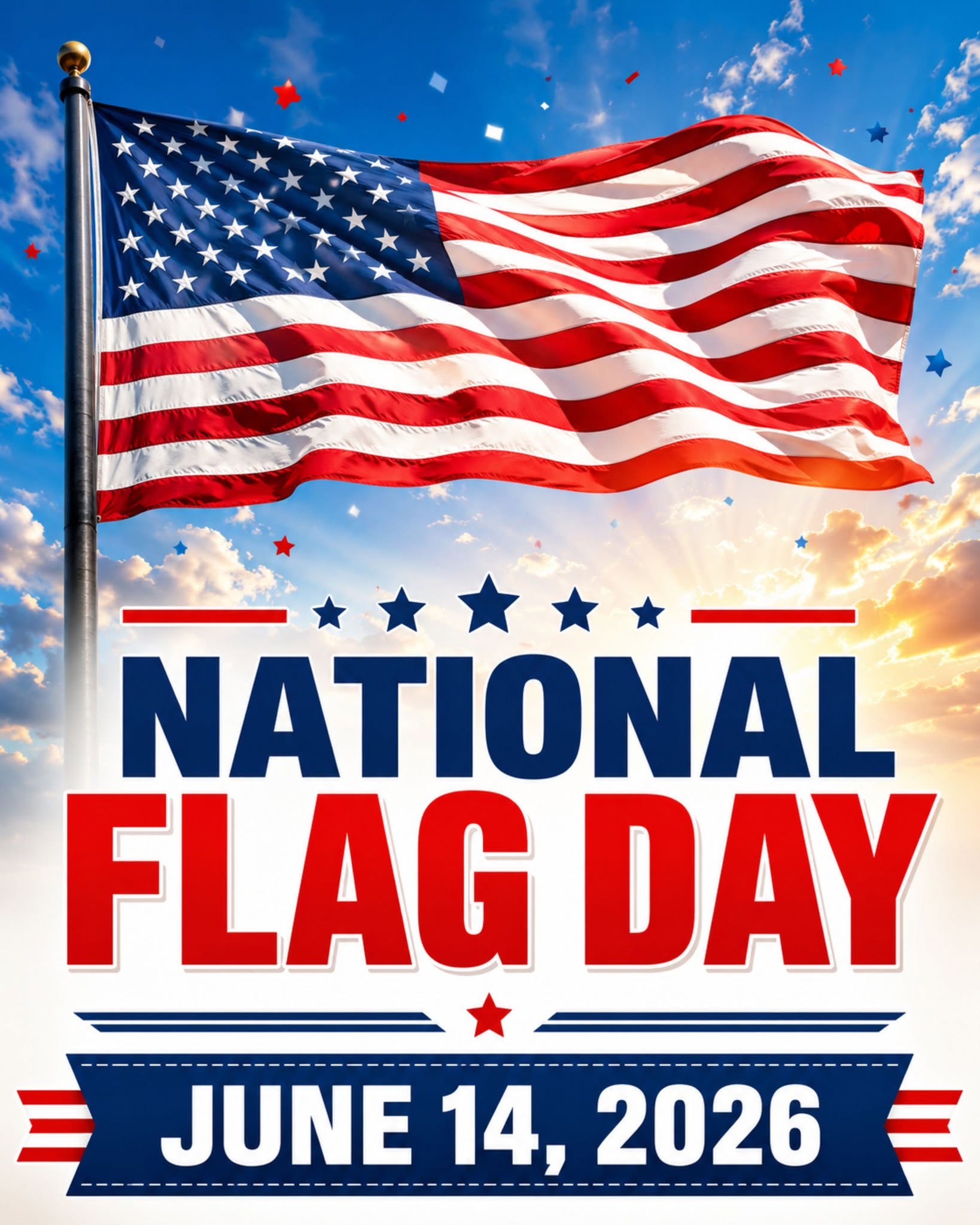
As Americans celebrate Flag Day on June 14 and prepare for the nation's historic 250th anniversary, few symbols remain as instantly recognizable-or as deeply meaningful-as the American flag.
Flying above homes, schools, churches, government buildings, and military bases, the Stars and Stripes has become a powerful representation of freedom, sacrifice, and national identity. Yet the story behind the flag is far more complex than many Americans realize.
Flag Day commemorates June 14, 1777, when the Continental Congress approved a resolution establishing a national flag for the newly independent United States. The resolution itself was remarkably brief, stating simply that the flag should feature thirteen stripes alternating red and white, along with thirteen white stars on a blue field representing a new constellation.
At the time, however, Congress did not specify who designed the flag.
For generations, Americans have associated the flag's creation with Betsy Ross, the Philadelphia seamstress said to have sewn the first Stars and Stripes after meeting with George Washington and other Revolutionary leaders.
The story remains one of the most beloved legends in American history. Yet most historians now believe there is little contemporary evidence supporting the claim. The account first emerged publicly nearly a century later when Ross' grandson, William Canby, presented the story to a historical society in 1870.
Researchers have since searched congressional records, personal correspondence, journals, and other Revolutionary-era documents without finding proof that such a meeting ever occurred.
That does not mean Ross had no connection to flag-making. Historians generally agree she was an accomplished upholsterer and seamstress who likely produced flags during the Revolutionary period. What remains disputed is whether she designed the nation's first flag.
Many scholars instead point to Francis Hopkinson, a signer of the Declaration of Independence and member of the Continental Congress. Hopkinson helped design several early national symbols and later petitioned Congress for payment for his work on official government seals and flags.
Although definitive proof remains elusive, historians generally view Hopkinson as the strongest documented candidate for the flag's designer.
The flag itself has evolved significantly since the eighteenth century.
The original version featured thirteen stars and thirteen stripes representing the original colonies. As the nation expanded westward and new states joined the Union, additional stars were added. The current flag, adopted in 1960 after Hawaii became the 50th state, contains fifty stars while retaining the original thirteen stripes as a tribute to the nation's founding colonies.
Over the centuries, the American flag has appeared at some of the most defining moments in the nation's history. It flew over battlefields during the Revolutionary War and Civil War, inspired Francis Scott Key to write "The Star-Spangled Banner" during the War of 1812, accompanied troops during both World Wars, and was planted on the Moon during the Apollo 11 mission in 1969.
The flag has also become a symbol that transcends politics. For many Americans, it represents not only the country's past achievements but also its ongoing pursuit of liberty, justice, and opportunity.
The modern observance of Flag Day emerged in the late nineteenth and early twentieth centuries as civic groups sought to encourage patriotism and historical awareness. In 1916, President Woodrow Wilson issued a proclamation recognizing June 14 as Flag Day. More than three decades later, President Harry Truman signed legislation officially establishing the observance in 1949.
This year's Flag Day carries added significance as the nation approaches July 4, 2026, the 250th anniversary of the Declaration of Independence. Across the country, communities are already preparing celebrations that will honor both the nation's founding and the enduring symbol that has represented it for nearly two and a half centuries.
Whether viewed as a historical artifact, a patriotic emblem, or a reminder of the ideals upon which the nation was founded, the American flag remains one of the most powerful symbols in the United States. And while debates about its origins may continue, its place in American history is unquestioned.


