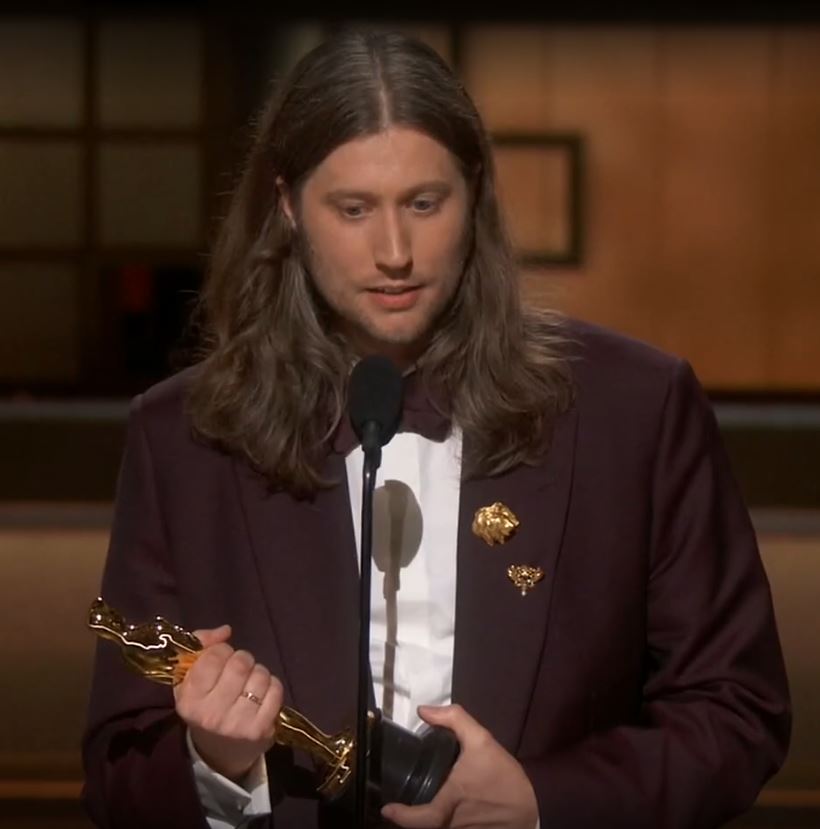
He walked into the Mississippi Delta as a white Swede who grew up on Metallica. He walked out with the soul of the blues - and tonight, his third Oscar.
Ludwig Göransson has won the Academy Award for Best Original Score at the 98th Academy Awards for Sinners - his third Oscar win following Black Panther in 2019 and Oppenheimer in 2024, and arguably his most personal, most ambitious, and most spiritually resonant work of his career.
Göransson is a two-time Academy Award-winning composer whose score for Sinners was nominated for six Grammy Awards - a film whose music critics and audiences alike described not merely as a soundtrack but as the lifeblood and soul of the entire movie.
The trophy was a long time coming. But the guitar that won it was longer.
A 1932 Guitar. A Swedish Kid. A Mississippi Education.
"I never imagined I'd score a film about a guitar player - it hits close to home," Göransson said when the project was announced. "My dad, a guitar teacher at the local school and a die-hard blues fanatic, put a guitar in my hands when I was six. If it were up to him, I'd be named Albert - for Albert King, the legendary guitarist."
But there was a problem. "Who am I to sit down and try to write a blues score?" Göransson recalled asking himself. "I didn't know where to start. Blues was always my dad's thing. What is my part of this? How do I find myself in this expression?"
The answer came the same way most real answers come - by showing up in person.
One of the first things Göransson and Ryan Coogler did was travel to Mississippi and go down to the Delta together - visiting the B.B. King Museum, local juke joints in Clarksdale and Indianola, and eventually landing at Royal Studios in Memphis, owned by legendary blues producer Lawrence "Boo" Mitchell, where some of the most important recording sessions in the history of American music have taken place.
Göransson and his wife Serena - a classically trained violinist who served as executive music producer - rented a house in New Orleans for three months and lived there during the shoot. "I feel like a steward with this project," Serena said. "Especially with the music. I just feel that it has a life of its own and the right artists are coming in to collaborate with us at the right time."
The instrument at the center of everything was a guitar nobody had touched in nearly a century.
"I perform it on a 1932 Dobro Cyclops resonator - the very same guitar that Preacherboy Sammie carries throughout the film," Göransson said. "I wrote most of the score on this guitar. I bought it in Los Angeles right before we shot the film, because the movie takes place in 1932 and this amazing Dobro is from 1932." He found one of only three known to exist in the world - one in London, one in Nashville, one in Los Angeles.
29 Music Moments. One Mission. No Room for Nostalgia.
The scale of the challenge was enormous. "There were 29 individual music moments that we had to account for, and we didn't want it to feel like a musical," Serena Göransson said. "We wanted it to feel as lived-in. Just as organic and natural, and a part of everyday life."
The score begins almost entirely acoustically - the intimate sound of a single guitar in a cotton field - and then as the story builds toward darkness, it transitions into heavy metal, orchestra, strings, and thundering drums. Every genre shift mirrors what is happening spiritually on screen.
"Beyond feeling raw and lived in, we wanted it to be firmly rooted in its true origin story," Göransson said. "We weren't aiming for nostalgia; we wanted it to feel immediate. Much of the music was written and recorded on set during the shoot, with the cast and crew working alongside us. That process gave the film a sound that's connected to the past, alive in the moment."
Michael B. Jordan himself noted he had never been on a set where they filmed to the actual music that would appear in the final cut - the score was not added later but woven into every moment of production from the very first day of shooting
The legends who showed up to help were extraordinary. Göransson enlisted blues icons including Buddy Guy, Christone "Kingfish" Ingram, and 94-year-old Bobby Rush - who flew overnight from Seattle to New Orleans on a single phone call from Serena the night before his scene was scheduled to shoot, arriving just in time to sit in a chair on set and play harmonica while Delroy Lindo filmed beside him.
Music as a Spiritual Force
Göransson has described the music of Sinners as a spiritual force - a vehicle to tell the stories of the past and be a voice for the voiceless. The film opens with a line that his score had to live up to: music described as "so pure it can pierce the veil between life and death, past and future." Then it proceeds to show exactly what that sounds like.
In the film's most ambitious sequence - a surreal music montage unlike anything in recent cinema - Göransson weaves together traditional African music, the blues, funk, jazz, gospel, and hip-hop into a single continuous musical river, tracing the entire history of Black American music from its roots to the present in one unbroken flow.
The Wall Street Journal called Göransson's score "a twangy marvel of genre-crossing interpolation." IndieWire wrote that it created "a blues sound that cuts a hole straight through the decades." The BFI simply called it the recreation of the devil's music - the phrase historically used to condemn the blues as ungodly, now reclaimed as an act of cultural resurrection.
For the Christian community, the spiritual stakes of this score are impossible to separate from its artistic achievement. The blues was born at the crossroads of the sacred and the secular - a music that emerged from the same Black Southern church tradition that gave the world gospel, spirituals, and the sound of people crying out to God in the middle of unbearable suffering. Göransson understood this. "The fingerprints of the blues are present in virtually all popular music that has existed since," he said. "And we wanted the music of Sinners to reflect that."
A Swedish boy whose father named him after no one - but almost named him after a blues legend - just won his third Oscar for honoring the music that built the modern world. He played every note of it on a guitar that was already old when the Great Depression began.
Tonight that guitar sang its way into Oscar history.
Read our full Oscars 2026 winners list here.


