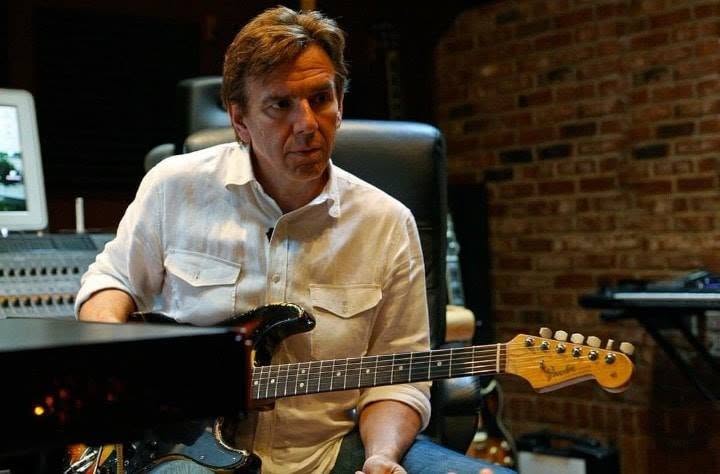
Few musicians have shaped both Christian music and country music quite like Dann Huff.
For more than four decades, Huff has quietly built one of the most extraordinary careers in the music industry. He was there during the formative years of contemporary Christian music, helped launch White Heart into the emerging Christian rock scene, became one of Los Angeles' most sought-after session guitarists, and later transformed modern country music as the producer behind countless hit records by artists including Keith Urban, Rascal Flatts and Faith Hill.
Now, in a wide-ranging conversation with Andy Chrisman on the One Degree of Andy podcast, Huff is pulling back the curtain on the remarkable-and often unexpected-journey that connected all of those worlds.
Long before he was producing country superstars, Huff grew up in a household immersed in Christian music. His father, legendary arranger Ronn Huff, worked closely with Bill Gaither, exposing the young musician to recording sessions, orchestras and the inner workings of Nashville's gospel music scene from an early age. Yet despite those roots, Huff admits he was captivated by guitars, rock music and the emerging Jesus Music movement.
"I heard Larry Norman and Randy Matthews," Huff recalls. "Now we can have a conversation because at least there were guitars."
Those influences eventually led him to become one of the founding members of White Heart. Playing alongside Steve Green, Billy Smiley and other future CCM pioneers, Huff helped establish one of Christian rock's defining bands before making a decision that surprised nearly everyone around him.
When opportunities arrived in Los Angeles, Huff chose to leave White Heart behind.
Rather than remain in Christian music, he pursued life as a studio guitarist-a move that changed the course of his career forever. Looking back, Huff laughs that the decision didn't sit well with everyone in the band, but he believed he had to follow where the music was leading him. Before leaving, he personally recommended his close friend Gordon Kennedy as his replacement, helping shape what many fans would later regard as White Heart's classic era.
Los Angeles quickly became home to an astonishing list of recording sessions.
Huff found himself playing guitar for Michael Jackson, Madonna, Barbra Streisand, Rod Stewart, Whitesnake, Chaka Khan, Boz Scaggs and countless other artists while becoming one of the industry's most respected session musicians. Ironically, those pop successes soon brought him back into Christian music, where producers such as Brown Bannister began calling him to perform on albums by Amy Grant, Michael W. Smith and DC Talk.
Yet another unexpected chapter was waiting.
Although Huff freely admits he "hated country music" growing up, Nashville producers saw something different. They weren't looking for another traditional country guitarist-they wanted someone who could inject fresh rock influences into country records without losing their identity. Producer James Stroud became one of the first to embrace Huff's unique sound, hiring him on project after project and helping establish him as one of Nashville's first-call guitarists.
The breakthrough only accelerated after a chance encounter with legendary producer Mutt Lange.
Huff tells the humorous story of Lange initially refusing to use him on Shania Twain's upcoming album because, as Lange bluntly put it, "You don't know anything about country music." Several months later, Lange changed his mind, explaining that while Huff might not know traditional country, nobody else could create the distinctive guitar sound he wanted. The result was Huff playing on "Any Man of Mine," one of the defining songs that helped launch Twain into global superstardom.
That relationship opened the door to producing.
Faith Hill became one of Huff's first major production successes after Lange personally recommended him for the project. Soon afterwards came hit records with Lonestar, followed by enormously successful collaborations with Rascal Flatts and Keith Urban that helped define the sound of country radio throughout the late 1990s and 2000s.
Among the interview's most memorable moments is Huff's reflection on working alongside Keith Urban. While Huff was known for crafting technically perfect vocal performances, Urban challenged him with a radically different philosophy.
"You're making me sound too good," Urban once told him during a recording session.
The comment initially caught Huff off guard. Urban explained that perfection wasn't the goal-emotion was. He wanted listeners to feel like the music might "fall off the track" rather than sound polished beyond recognition. Huff says that conversation permanently changed the way he approached producing records and remains one of the most important lessons of his career.
The interview also reveals the spiritual foundation that sustained Huff while navigating some of the music industry's biggest stages.
Asked how his father taught him to witness to non-Christian musicians, Huff recalls receiving an answer he never expected.
"I pay them on time."
His father explained that integrity, respect and treating people with dignity would always speak louder than words. For Huff, that philosophy became the blueprint for living out his faith while working with artists from every imaginable background.
Today, after producing hundreds of hit songs and performing on thousands more, Huff has returned to where it all began-with the guitar.
His new instrumental album, When Words Aren't Enough, marks his first solo project and reflects a deeply personal musical journey. Rather than showcasing technical virtuosity for its own sake, Huff describes the record as rediscovering the simple joy of making music and reconnecting with the instrument that first captured his imagination as a teenager.
For fans of Christian music, country music and Nashville history, Huff's conversation is far more than a career retrospective. It offers a rare glimpse into the life of a musician whose fingerprints can be found across nearly every corner of modern popular music-and whose remarkable journey from Bill Gaither to country music royalty is still unfolding.


